
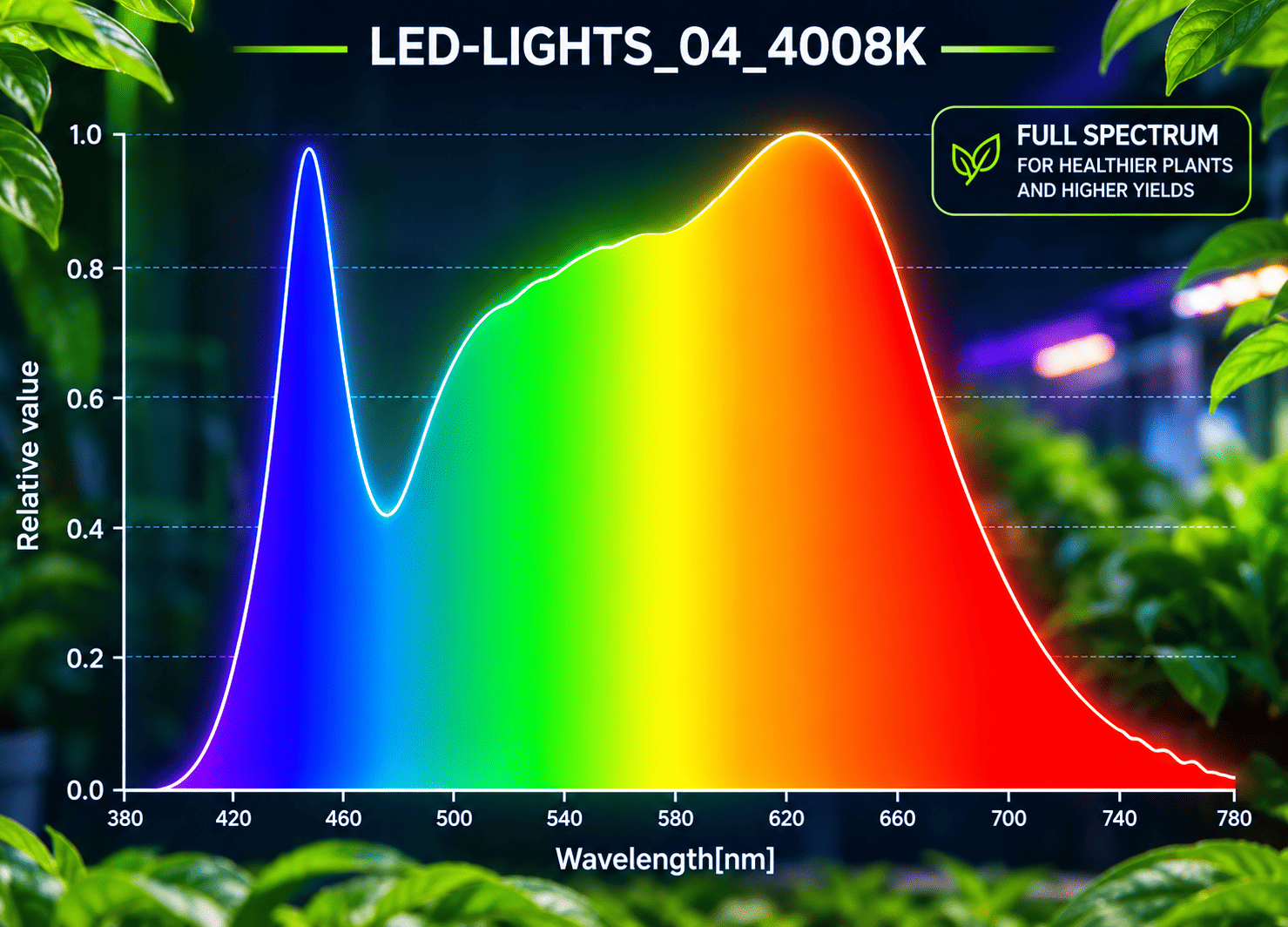
There is definitely no shortage of grow light sellers claiming their LEDs are "full spectrum" when they really aren't. Let's break down a few different light spectrums so you know exactly what to look for.
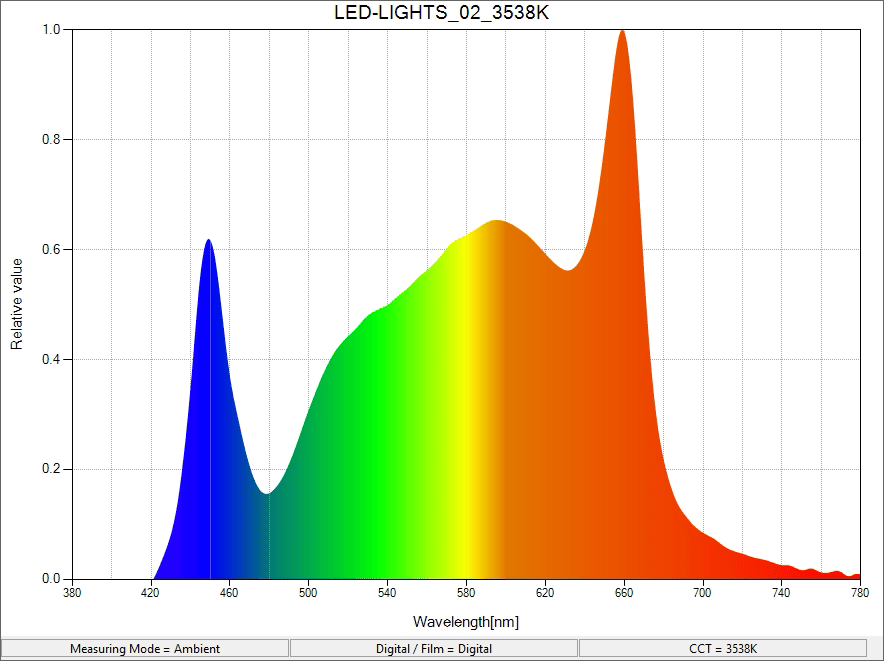
Spectrum Breakdown & Characteristics
What It Is Good For Growing
- Fruiting and Flowering Stage Crops:Tomatoes, Peppers, Strawberries, and Cannabis:
The dominant 660 nm peak maximizes flower initiation, fruit set, biomass accumulation, and yield weight during reproductive stages. - Full-Cycle Heavy Feeders:
Provides balanced lighting for plants grown seed-to-harvest under a single spectrum, ensuring enough blue (~0.6 intensity) to maintain structure while heavily favoring flowering/fruiting energy. - Dense Canopy Crops:
The substantial green/yellow region (500–600 nm) penetrates deeper through upper leaf layers than blue or red alone, driving photosynthesis in lower foliage.
What It Is NOT Good At Growing (Limitations)
- Compact Microgreens & Early Seedling Nurseries:
High red-to-blue ratios encourage inter-nodal elongation (stretching). For tight, compact micro-greens (e.g., brassicas, radish) or short seedling propagation, higher blue fractions (4000K–5000K or 450 nm spikes) prevent leggy growth much more effectively. - Color Enhancement in Red Leafy Greens:
Anthocyanin accumulation (which gives red lettuce, red mizuna, or purple basil their dark pigment) is strongly driven by UV-A and intense blue light (~450 nm). The ~0.6 blue-to-red ratio here may produce greener, less pigmented leaves in specialty red leafy varieties. - Sole-Source Vegetative Mass Production:
While it can grow vegetative crops, using a high 660 nm red profile for purely vegetative leafy greens can lead to unnecessary stem extension and looser canopy structures compared to a balanced 4000K profile.
The aforementioned is clearly not a full-spectrum fixture. Let's take a look at what full-spectrum looks like.
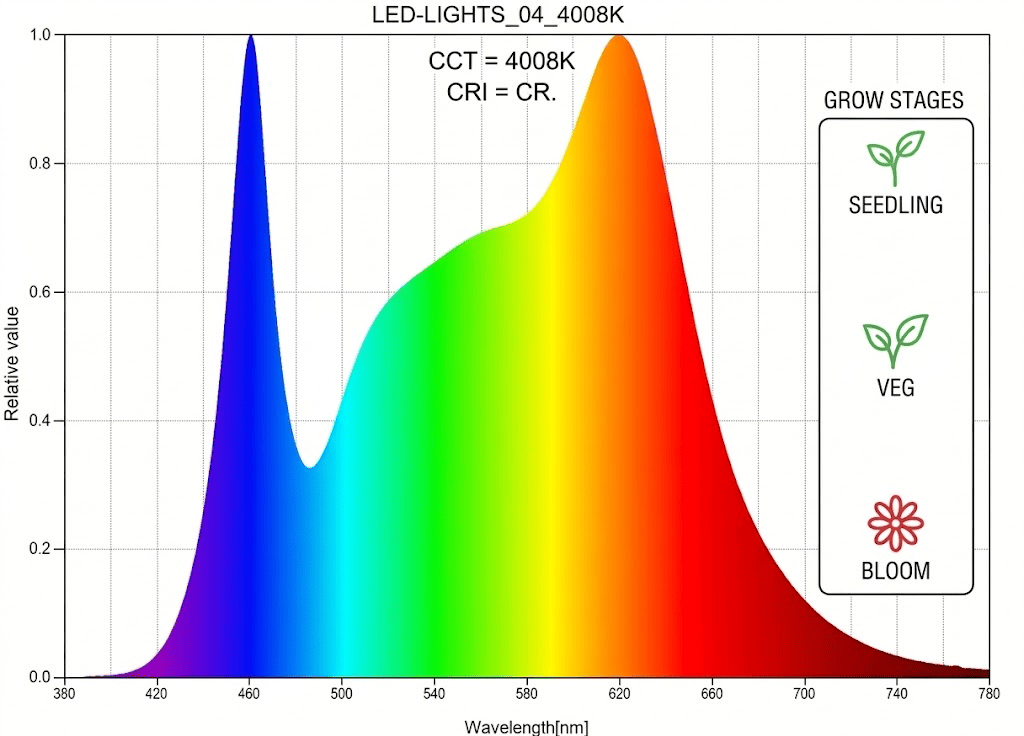
What This Light IS Good For
Full-Cycle Growth (Seed to Harvest):
The dual-peak balance provides strong blue energy (~450 nm) for compact vegetative growth alongside heavy red energy (~625–660 nm) needed for flowering and fruit development. It acts as a versatile, all-in-one spectrum across multiple plant growth stages.
Fruiting & Flowering Crops:
The prominent red peak directly hits the primary absorption band for Chlorophyll a, driving biomass accumulation, flowering initiation, and fruit set in crops like dwarf peppers, strawberries, and micro-tomatoes.
Dense Canopies & Deep Penetration:
The broad green and yellow region (500–600 nm) penetrates deeper into multi-layered leaf canopies than red or blue light alone, maintaining photo-synthetically active lower foliage.
Root Mass & Photomorphogenesis:
The smooth shoulder extending into the 700–750 nm far-red region works together with the 660 nm red photons to trigger the Emerson enhancement effect, boosting overall photosynthetic efficiency and supporting healthy root expansion.
What This Light IS NOT Good For
Exclusive Micro-green & Seedling Trays:
Because the spectrum carries significant red energy (peaking at 1.0 around ~630 nm), using it strictly for fast-turn micro greens or early propagation can encourage slightly more stem elongation (stretching) compared to a higher-blue/cooler profile (such as a 5000K spectrum).
Maximizing Pigmentation in Red/Purple Leafy Varieties:
While the blue peak (~450 nm) is strong, the high proportion of red energy may result in less intense anthocyanin accumulation (deep red/purple coloration) in specialty crops like red oak leaf lettuce, purple basil, or red mizuna compared to lights with heavy UV-A or high blue-to-red ratios.
Targeted Vegetative-Only Racks:
For setups dedicated strictly to non-flowering leafy greens (e.g., spinach, kale, head lettuce), generating high red/deep-red energy is less energy-efficient than using a dedicated neutral or cool vegetative spectrum (like 4000K–5000K without the extra red bump).
Never take a seller’s word on LED performance. Protect your investment by demanding a verified spectrum analysis. If they refuse to provide you with a verified spectrum analysis, you should consider looking elsewhere.