The Future of Indoor Gardening Is Living Soil and Precision Climate Control
Indoor gardening is changing.
For years, hydroponics has dominated the conversation around controlled-environment agriculture. Vertical hydroponic farms, nutrient reservoirs, pumps, aeration systems and automated dosing have become synonymous with high-tech indoor growing.
But there is a fundamental problem with this approach:
The more complicated the growing system becomes, the more variables there are to control.
There is another way.
The future of indoor gardening is not necessarily about building a more complicated root system. It is about creating a healthier biological root environment and then controlling the climate around the plant with precision.
That means living soil + Vapour Pressure Deficit (VPD) + precision climate control.
And this is where the FLORA IV Climate Replicator changes the equation.
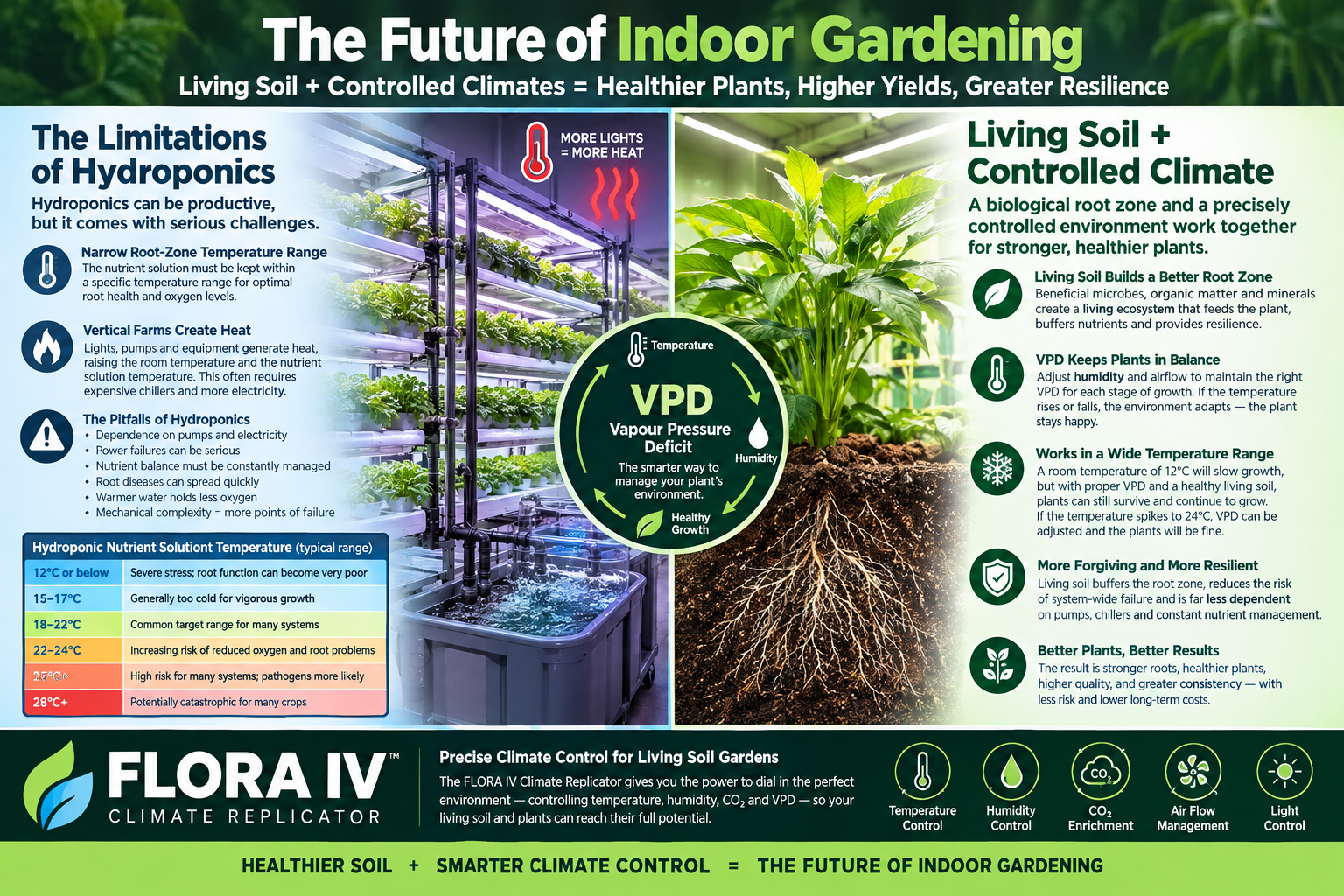
Hydroponics Has a Temperature Problem
Hydroponics can produce excellent plants. But hydroponic growing depends heavily on maintaining the correct conditions in the nutrient solution.
For many common hydroponic crops, growers generally aim for a nutrient-solution temperature around 18–22°C.
As solution temperature increases, dissolved oxygen availability decreases and the risk of root-zone problems can increase.
A simplified guide looks like this:
| Nutrient Solution Temperature | General Consideration |
|---|---|
| 12°C or below | Extremely cold; root activity and nutrient uptake can be severely impaired |
| 15–17°C | Cold for many crops and can significantly slow growth |
| 18–22°C | Common target range for many hydroponic systems |
| 22–24°C | Increasing concern for oxygen availability and root health |
| 25–27°C | Higher risk of root stress and pathogen problems |
| 28°C+ | Very high-risk conditions for many hydroponic crops |
The exact optimum depends on the crop and the type of hydroponic system. But the fundamental problem remains:
Hydroponics has a relatively narrow root-zone temperature window; vertical farming makes this problem even more significant.
Vertical Hydroponic Farms Create Heat
Imagine a room containing hundreds or thousands of plants stacked vertically. Every level requires lighting. There are pumps. There are fans. There are nutrient pumps. There are circulation systems. There are controllers and other electrical components.
All of that equipment consumes energy—and virtually all of that electrical energy ultimately becomes heat inside the growing environment.
The result?
The more production you put into the room, the more heat you have to remove.
This creates a difficult cycle for hydroponic growers.
More plants → more lights → more electricity → more heat → warmer nutrient solution → greater need for cooling.
Eventually, the hydroponic operation may require dedicated nutrient-solution chillers just to keep the root zone within its preferred operating range.
That adds:
- More equipment
- More electricity
- More maintenance
- More plumbing
- More points of failure
- More capital cost
The irony is hard to miss.
You create a highly efficient vertical farm, and then you have to spend additional energy removing the heat created by the system.
The Hidden Complexity of Hydroponics
Hydroponics is often marketed as simple:
Water + nutrients + roots = plants.
In practice, commercial hydroponics can be considerably more complicated. The grower may need to constantly monitor and manage:
- Nutrient concentration
- EC
- pH
- Water temperature
- Dissolved oxygen
- Reservoir levels
- Pumps
- Aeration
- Water quality
- Nutrient dosing
- Root health
- Filtration
- Circulation
- Pathogen control
And when one component fails, the consequences can happen quickly.
A failed pump can stop circulation.
A failed aerator can reduce oxygen availability.
A failed chiller can allow solution temperatures to climb.
A nutrient imbalance can affect the entire system.
A contaminated reservoir can potentially spread problems throughout a connected growing system.
Hydroponics can be extremely productive—but it can also be mechanically dependent and unforgiving.
Living Soil Takes a Different Approach
Now consider living soil. Living soil is not simply dirt in a container. It is a biological ecosystem. A properly developed living soil can contain beneficial microorganisms, fungi, organic matter, minerals and other components that interact with the plant's root system.
Instead of delivering every nutrient directly through a carefully managed water reservoir, the soil provides a biological environment in which nutrients are stored, transformed and made available to the plant.
The soil becomes a living component of the growing system.
And that changes everything.
Living Soil Provides Biological Buffering
One of the biggest advantages of living soil is its ability to provide a degree of biological and physical buffering.
Soil can hold water.
Soil can hold nutrients.
Organic matter can support microbial activity.
Microorganisms interact with the root zone.
The root environment is not dependent on a constantly circulating nutrient solution.
This doesn't mean living soil is maintenance-free.
It means the system is fundamentally different.
Instead of trying to control every aspect of the root environment mechanically, the grower can establish a healthy biological system and then focus on controlling the environmental conditions surrounding the plant.
And one of the most important environmental variables is Vapour Pressure Deficit.
Vapour Pressure Deficit: The Missing Piece of Indoor Gardening
Vapour Pressure Deficit, or VPD, is one of the most powerful tools available to the modern indoor grower.
Temperature alone doesn't tell you what the plant is experiencing.
Neither does relative humidity alone.
VPD combines temperature and humidity to describe the atmosphere's ability to draw moisture from the plant.
That makes VPD especially useful for managing transpiration.
Instead of simply saying: "The room must be 22°C."
A precision grower can ask: "What VPD does the plant need at this stage of growth?"
That is a much more sophisticated approach to indoor gardening.
What Happens When Temperature Changes?
This is where living soil and controlled climate become especially powerful. Imagine your indoor garden is operating at 20°C. Suddenly, the room warms to 24°C. A conventional temperature-only approach sees a problem:
The temperature changed.
A VPD-based approach sees an opportunity to respond.
Humidity can be adjusted to compensate for the change in temperature and bring the atmospheric conditions back toward the desired VPD range.
The plant doesn't experience temperature in isolation. It experiences temperature, humidity and atmospheric moisture demand together. This is the power of Vapour Pressure Deficit.
What About a Cold Room?
Consider an extreme example. Suppose the surrounding room temperature drops to 12°C.
A hydroponic system with a 12°C nutrient solution would generally be far outside the preferred root-zone temperature range for many crops. Root activity and nutrient uptake could become severely impaired, particularly if the condition persisted.
Living soil doesn't make 12°C an ideal growing temperature—it isn't. Plants are still biological organisms, and cold temperatures will slow physiological processes.
But the critical distinction is that the plant's roots are not necessarily being immersed in a 12°C nutrient solution. The soil provides a substantially different root environment.
And as the atmospheric conditions change, VPD can be managed accordingly. This gives a living-soil garden greater flexibility and resilience than a system whose root environment depends on maintaining a tightly controlled liquid reservoir.
What If the Temperature Suddenly Spikes to 24°C?
This is where precision climate control becomes extremely valuable. A sudden temperature increase doesn't have to mean that the plant is suddenly exposed to an uncontrolled atmospheric environment.
With an advanced climate-control system, humidity can be adjusted in response to temperature changes. The objective is to maintain the appropriate VPD for the plant.
Temperature changes.
Humidity responds.
VPD stays within the desired range.
That is intelligent environmental control.
Of course, VPD isn't magic. Extreme temperatures can still stress plants, and root-zone temperature still matters in living soil. But VPD gives the grower a powerful additional control variable that simply doesn't exist when temperature is treated as the only important atmospheric measurement.
Stop Controlling the Plant. Control the Environment.
This is the fundamental philosophy behind the next generation of indoor gardening. Instead of constantly fighting the consequences of the growing system, create an environment that works with the plant.
Instead of asking:
"How do I keep this nutrient reservoir at the perfect temperature?"
Ask:
"How do I create the ideal environment for the plant?"
Instead of simply monitoring room temperature, monitor Vapour Pressure Deficit.
Instead of replacing a natural biological root ecosystem with a reservoir, cultivate living soil.
Instead of allowing the growing room to fluctuate wildly, precisely control the climate.
This is the future.
Introducing the FLORA IV Climate Replicator
The FLORA IV Climate Replicator is designed around this philosophy.
Rather than simply being another piece of grow-room equipment, FLORA IV is designed to give indoor growers precise control over the environmental conditions surrounding their plants.
That means controlling the variables that matter:
Temperature Control
Maintain the desired temperature range for your growing environment.
Humidity Control
Precisely manage relative humidity as environmental conditions change.
VPD Management
Use Vapour Pressure Deficit as a primary environmental control strategy rather than relying on temperature alone.
Air Movement
Maintain consistent air circulation throughout the growing environment.
CO₂ Management
Provide controlled CO₂ enrichment when appropriate for the crop and growing strategy.
Light Management
Coordinate the growing environment with the plant's photoperiod and lighting requirements.
Together, these controls create something far more valuable than a temperature-controlled room.
They create a controlled climate for the plant.
Living Soil + FLORA IV
This is where the real opportunity exists.
Living soil provides the biological foundation.
VPD provides intelligent atmospheric management.
FLORA IV provides precision climate control.
The result is an indoor growing environment designed around the biology of the plant rather than the limitations of a nutrient reservoir. This approach can also reduce dependence on some of the mechanical infrastructure associated with large hydroponic operations.
No constantly circulating nutrient solution is required simply to deliver nutrients to the roots. No nutrient reservoir needs to be kept within a narrow temperature window.
No hydroponic chiller is required merely because the room's heat is raising the temperature of the nutrient solution. The grower can concentrate on the plant.
The Future of Vertical Farming May Look Different
Vertical farming isn't going away. But the next generation of vertical farming may look very different from today's highly mechanical hydroponic farms.
Imagine vertical growing systems using living soil or soil-based substrates, combined with precision environmental control. The plants occupy the vertical space.
Living soil supports the roots. Sensors continuously monitor the environment. VPD becomes a key control parameter. Climate systems respond automatically.
Instead of constantly fighting the conditions inside the building, the building becomes part of the growing system. That is a much more intelligent approach.
Why VPD Is the Future of Indoor Gardening
The indoor gardening industry has spent years obsessing over temperature. But temperature is only one part of the equation.
Vapour Pressure Deficit gives growers a better way to understand the relationship between temperature, humidity and plant transpiration.
A grow room at 22°C and 40% humidity is not the same environment as a grow room at 22°C and 70% humidity. The thermometer may show the same number.
The plant does not experience the same atmospheric conditions.
This is why VPD matters.
And this is why the future of indoor gardening will increasingly move toward climate-based cultivation rather than temperature-based cultivation.
The Bottom Line
Hydroponics is an impressive technology. But it comes with complexity. It requires carefully managed nutrient solutions. It is sensitive to root-zone temperature. It can require extensive pumping and aeration.
Vertical hydroponic farms generate substantial amounts of heat. And as the operation grows, so does the complexity of managing water temperature, oxygen, nutrients and circulation. Living soil offers another path. A biological root environment. Nutrient and moisture buffering. Less dependence on continuously circulating nutrient solution.
And, when combined with precision environmental control, the ability to manage the atmosphere around the plant using Vapour Pressure Deficit.
That is the real opportunity.
The Future Is Not Just Indoor Gardening.
The future is precision climate-controlled indoor gardening.
Living soil provides the foundation.
Vapour Pressure Deficit (VPD) provides the strategy.
And FLORA IV Climate Replicator provides the technology to bring the environment under control.
Don't just grow plants indoors.
Create the climate they were meant to grow in.
FLORA IV Climate Replicator
Precision Climate Control for the Future of Indoor Gardening.