While hydroponic growing is often marketed as a clean, high-tech way to cultivate fresh produce at home or commercially, it comes with hidden environmental and health risks that most growers overlook. Beneath the glossy exterior of fast-growing plants lies a complex supply chain and a disposal problem that poses serious threats to both human health and local ecosystems.
The Global Supply Chain and the Heavy Metal Threat
Most modern hydroponic systems rely heavily on synthetic mineral salts to deliver essential nutrients directly to plant roots. However, a major vulnerability lies in where these synthetic minerals are manufactured.
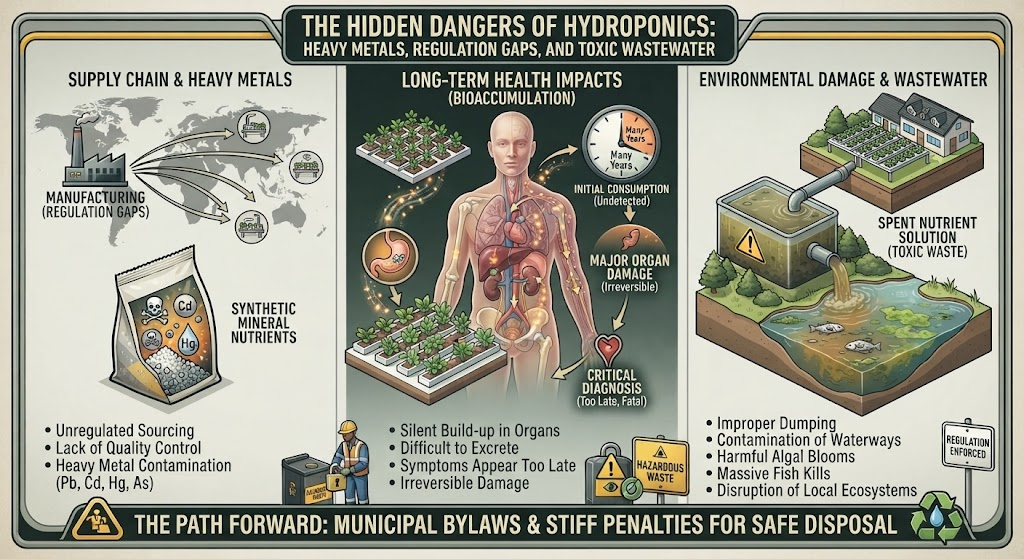
Many commercial fertilizer salts are sourced from countries with a distinct lack of environmental and industrial safety oversight. Without rigorous regulatory frameworks or strict manufacturing inspections, toxic impurities—most notably heavy metals like lead, cadmium, arsenic, and mercury—frequently contaminate these chemical fertilizers.
The Silent Accumulation in the Human Body
Unlike acute poisoning, which causes immediate illness, heavy metals introduced through unmonitored synthetic nutrients present a slow, insidious danger:
- Long-Term Bioaccumulation: Heavy metals are notoriously difficult for the human body to excrete. Over years of consuming produce grown in contaminated synthetic solutions, these toxins quietly build up in your organs, bones, and tissues.
- The "Too Late" Diagnosis: Because accumulation happens gradually over many years, symptoms often do not appear until major organ damage has already occurred. By the time routine testing uncovers heavy metal toxicity, the damage is frequently irreversible and, in severe cases, can prove fatal.
Spent Hydroponics Solution is Toxic Waste
The safety hazards do not end at harvest time; they extend directly into what you do with the leftover water.
Spent hydroponic nutrient solution is not ordinary wastewater. There's a possibility of While hydroponic growing is often marketed as a clean, high-tech way to cultivate fresh produce at home or commercially, it comes with hidden environmental and health risks that most growers overlook. Beneath the glossy exterior of fast-growing plants lies a complex supply chain and a disposal problem that poses serious threats to both human health and local ecosystems.
The Global Supply Chain and the Heavy Metal Threat
Most modern hydroponic systems rely heavily on synthetic mineral salts to deliver essential nutrients directly to plant roots. However, a major vulnerability lies in where these synthetic minerals are manufactured.
Many commercial fertilizer salts are sourced from countries with a distinct lack of environmental and industrial safety oversight. Without rigorous regulatory frameworks or strict manufacturing inspections, toxic impurities—most notably heavy metals like lead, cadmium, arsenic, and mercury—frequently contaminate these chemical fertilizers.
The Silent Accumulation in the Human Body
Unlike acute poisoning, which causes immediate illness, heavy metals introduced through unmonitored synthetic nutrients present a slow, insidious danger:
- Long-Term Bioaccumulation: Heavy metals are notoriously difficult for the human body to excrete. Over years of consuming produce grown in contaminated synthetic solutions, these toxins quietly build up in your organs, bones, and tissues.
- The "Too Late" Diagnosis: Because accumulation happens gradually over many years, symptoms often do not appear until major organ damage has already occurred. By the time routine testing uncovers heavy metal toxicity, the damage is frequently irreversible and, in severe cases, can prove fatal.
Spent Hydroponics Solution is Toxic Waste
The safety hazards do not end at harvest time; they extend directly into what you do with the leftover water.
Spent hydroponic nutrient solution is not ordinary wastewater. There's the chance it contains trace heavy metals, plus it's a concentrated cocktail of leftover chemical salts, and unabsorbed synthetic compounds. It should never be:
- Flushed down your household toilet or drain.
- Poured out onto your home garden or soil.
- Dumped into local storm drains, ditches, or nearby bodies of water.
Devastation to Aquatic Life and Water Systems
When concentrated fertilizer solutions are improperly dumped into the environment, they wreak havoc on local ecosystems. High concentrations of nitrogen, phosphorus, and trace minerals entering local waterways trigger rapid algal blooms, which deplete dissolved oxygen in the water.
For fish and other aquatic creatures, this sudden chemical surge is catastrophic. The resulting oxygen depletion and chemical toxicity cause massive fish kills, suffocate beneficial aquatic organisms, and disrupt local food webs.
The Path Forward: Municipal Action and Safe Disposal
As indoor growing and hydroponics continue to grow in popularity, local governments can no longer turn a blind eye to wastewater management.
Municipalities will soon need to pass strict bylaws prohibiting the illegal dumping of spent hydroponic solutions, backed by stiff penalties and fines for violators. Moving forward, growers will be required to treat spent nutrient solution for what it is: hazardous waste that must be safely contained and transported to a designated municipal recycling yard for proper environmental neutralization and disposal.It is a concentrated cocktail of leftover chemical salts, and unabsorbed synthetic compounds. It should never be:
- Flushed down your household toilet or drain.
- Poured out onto your home garden or soil.
- Dumped into local storm drains, ditches, or nearby bodies of water.
Devastation to Aquatic Life and Water Systems
When concentrated fertilizer solutions are improperly dumped into the environment, they wreak havoc on local ecosystems. High concentrations of nitrogen, phosphorus, and trace minerals entering local waterways trigger rapid algal blooms, which deplete dissolved oxygen in the water.
For fish and other aquatic creatures, this sudden chemical surge is catastrophic. The resulting oxygen depletion and chemical toxicity cause massive fish kills, suffocate beneficial aquatic organisms, and disrupt local food webs.
The Path Forward: Municipal Action and Safe Disposal
As indoor growing and hydroponics continue to grow in popularity, local governments can no longer turn a blind eye to wastewater management.
Municipalities will soon need to pass strict bylaws prohibiting the illegal dumping of spent hydroponic solutions, backed by stiff penalties and fines for violators. Moving forward, growers will be required to treat spent nutrient solution for what it is: hazardous waste that must be safely contained and transported to a designated municipal recycling yard for proper environmental neutralization and disposal.
The Gold Standard of Cultivation: Why Soil and Controlled Climates Win
While hydroponics often dominates the conversation around indoor growing, returning to actual living soil within a precision-controlled ecosystem delivers an unmatched standard of quality. When you pair rich, organic soil with advanced environmental automation like the FLORA IV Climate Replicator, you unlock the ultimate recipe for superior plant health.
Living soil provides a complex, natural microbial web that synthetic nutrient solutions simply cannot replicate, resulting in richer terpene profiles, superior flavors, and exceptional nutritional density in your crops. However, organic soil demands absolute environmental stability to thrive. That is where FLORA IV changes the game: by automatically locking in ideal temperatures, precise lighting cycles, and optimized vapour pressure deficit (VPD) 24/7, it eliminates the volatility of room climates.
Upgrade to a living-soil ecosystem powered by FLORA IV and experience the effortless harmony of traditional earth-grown quality backed by modern, professional-grade climate control.